


WALKABILITY INITIATIVES
Pedestrian infrastructure is one of the most essential elements of a liveable city. This is true particularly in a neighbourhood like Malleswaram, which has the potential to function as a true 15-minute neighbourhood. Recognising its importance, we focused on improving walkability through initiatives such as Footpath Beku and Walk2School and other campaigns.
Footpath Beku
Footpath Beku was launched to advocate for safer, more accessible, and pedestrian-friendly footpaths in Malleswaram. The campaign gained widespread attention through the viral video Bharatanatyam Saaku Footpath Beku, which humorously highlighted the challenges of navigating broken pavements and inspired similar advocacy efforts elsewhere. Over the years, the campaign also included initiatives such as the Elders' Walk and Belaku Beku, while working with the BBMP to improve walking infrastructure across the neighbourhood.
The 8th Main White Topping *
The 8th Main White Topping project highlighted the importance of community consultation in urban development. Revived in March 2025 without residents' consent, the project led to prolonged disruption due to delays, poor planning, and inadequate safety measures. Residents worked collectively to document these issues and engage with the authorities, advocating for greater transparency, accountability, and resident participation in future civic projects.
Walk2School
Walk2School was an initiative under the Footpath Beku campaign that focused on improving the safety and accessibility of school commutes in Malleswaram. It sought to reduce traffic congestion during school pick-up and drop-off hours by encouraging schools and parents to adopt more organised systems. At the same time, the initiative promoted walking to school by advocating for safer pedestrian routes, with the aim of making daily journeys safer for children.
18th Cross Level Footpath
One of the campaign's most significant achievements was the creation of a continuous level footpath along 18th Cross. During stormwater drain reconstruction, Malleswaram Social persuaded the BBMP to lay the drainage slabs at a consistent level rather than following the varying heights of individual gates and ramps. Volunteers then went door to door, encouraging residents to cooperate with the project and, wherever possible, adapt their entrances to support a continuous walking path. Where a level footpath could not be maintained, gentle ramps were incorporated to ensure accessibility. The project became a proof of concept for how cooperative planning between citizens and civic authorities could overcome practical challenges and create more accessible public infrastructure.
The completion of the 18th Cross Level Footpath was marked by 11 on 11—a community celebration held at 11 a.m. on 11 August 2018. The event recognised the collective efforts of residents, volunteers, and the BBMP, celebrating a project that demonstrated how cooperation could lead to meaningful improvements in public spaces.
The 15th Cross Footpath Documentation
The 15th Cross Footpath Documentation was an initiative to comprehensively document the challenges along a key stretch of pavement in Malleswaram. By identifying issues affecting accessibility, safety, and pedestrian movement, the project demonstrated how improving this important thoroughfare could benefit a large number of residents. The documentation was intended to support discussions with the authorities and advocate for improvements to the footpath infrastructure.
Railway Bridge Staircase
Railway Bridge Staircase focused on improving the pedestrian staircase linking 11th Main Railway Parallel Road to the Srirampura Metro bridge. Recognising the need for a safer and more welcoming public space, Malleswaram Social worked with architecture students from M.S. Ramaiah College to develop a redesign proposal. Although a public toilet was later constructed at the site, the larger proposal remains unrealised, and the group continues to advocate for a comprehensive upgrade to this vital pedestrian connection.


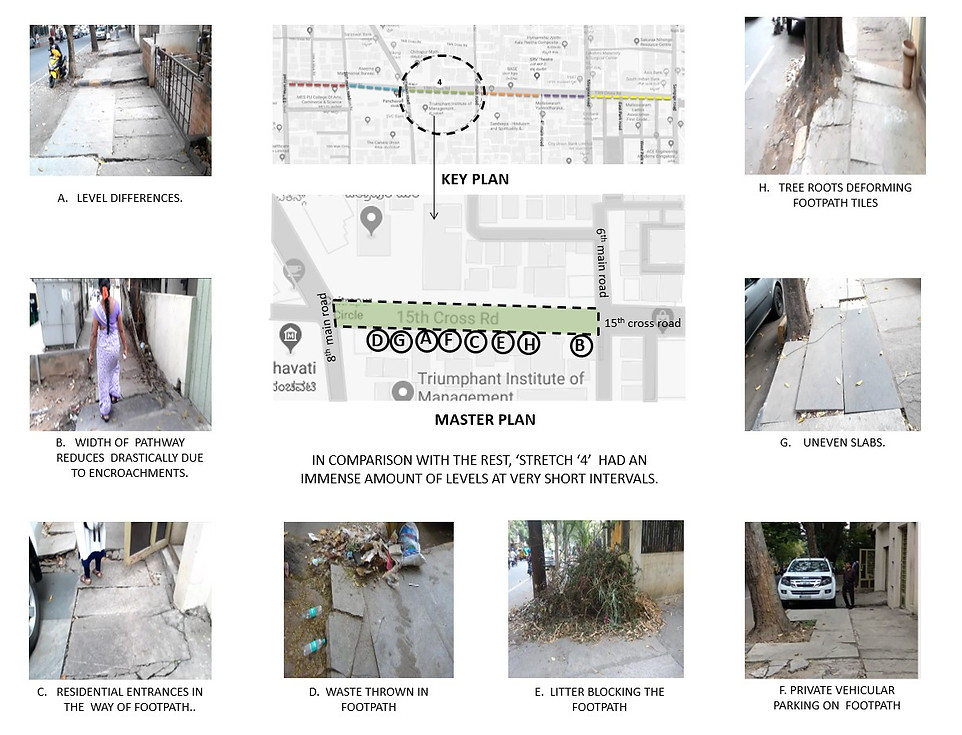
15th Cross Plan
SOLID WASTE MANAGEMENT
Recognising waste management as one of Malleswaram's most pressing civic challenges, Malleswaram Social adopted a multi-pronged approach that combined awareness, education, and hands-on action. Volunteers conducted door-to-door campaigns promoting waste segregation, organised talks and composting workshops with experts such as Vani Murthy and Vasuki Iyengar, and worked closely with residents, institutions, and Pourakarmikas to encourage more responsible waste disposal practices. From 2023 onwards, the group also began independent weekly clean-up and greening drives, transforming neglected garbage blackspots into cleaner, greener public spaces while engaging nearby residents and businesses in their upkeep. The initiative later expanded to include student volunteers from local colleges, making it an ongoing community effort to foster cleaner neighbourhoods and greater civic responsibility.
Wednesday Plog *
Wednesday Plog began as a weekly resident-led initiative to clean and green Malleswaram's public spaces. In partnership with the MLA Academy of Higher Learning Leo Club, the initiative grew to involve local students, introducing them to solid waste management through hands-on clean-up drives, street plays, and community outreach. By encouraging students to take ownership of the neighbourhood they study in, Wednesday Plog fostered civic responsibility and pride in shared public spaces.
8th Main Triangle *
8th Main Triangle grew out of Malleswaram Social's weekly neighbourhood clean-up drives, where volunteers worked with residents and local shops to keep public spaces clean. During one such drive, two neglected triangular plots on 8th Main were identified, cleared, and planted with the vision of transforming them into small neighbourhood interaction spaces. At a time when green public spaces and informal meeting places are increasingly scarce, the initiative highlighted how even the smallest leftover patches of land can be reclaimed to provide relief from the surrounding concrete landscape. It also served as a proof of concept for how collaboration between residents and the BBMP can create more thoughtful, liveable public spaces, with ongoing efforts to develop the site further with planting and seating.
*Ongoing initiatives


GOVERNMENT GIRLS HIGH SCHOOL
Government Girls' High School
Beginning in 2017, Malleswaram Social worked closely with the Government Girls' High School to help improve the school's learning environment and campus. Volunteers undertook clean-up drives on the campus including the heritage building, donated essential supplies such as fans, notebooks and school bags, introduced waste management initiatives, organised field trips and book clubs, and regularly engaged with students. This long-term partnership continued until the COVID-19 pandemic, reflecting the group's commitment to supporting neighbourhood institutions through community participation.
Anganwadi Montessori Initiative
Within the Government Girls' High School campus, Malleswaram Social helped establish a Montessori learning environment in the Anganwadi with support from the local MLA. Montessori educators from the community set up the classroom and spent a year training Anganwadi teachers, introducing child-centred teaching practices and helping strengthen early childhood education.


CARING SQUARES *
Caring Squares is an initiative that uses knitting and crochet to create handmade quilts for those in need. Participants make individual squares as per their convenience. These are joined together into quilts and distributed to maternity homes for newborn babies. The initiative is not confined to Malleswaram and has spread all through the city, and in some cases, contributions are coming outside bangalore too. This has createda warm and thriving group who continue to create beautiful items for donation

.jpeg)

SAAKU CAMPAIGN
Saaku Campaign emerged in the aftermath of the COVID-19 lockdown, when residents, finally able to step outside again, were met with dug-up roads, unfinished civic works, and unsafe public spaces. The campaign protested both the prolonged delays in infrastructure repairs and a proposal to build a concrete walkway through the 18th Cross Playground, arguing that the neighbourhood's precious open spaces should be preserved for play and community use. Through public demonstrations and dialogue with the local administration, the campaign called for more thoughtful planning and timely civic action.


_JPG.jpg)
PLASTIC BEDA BAGS BEKU
Plastic Beda Bags Beku was a community initiative that promoted alternatives to the use of plastic bags through awareness and direct action. Volunteers encouraged local vendors to reduce the use of plastic bags while distributing reusable cloth bags made by members of the community. The campaign also reached schools and colleges, educating students about the environmental impact of plastic waste and supporting the BBMP's efforts to reduce plastic consumption across Bengaluru.


