


In conversation with Nandini Karanji, founder of URVEE.
Seeds of Empowerment
Thirty-two years ago, I started Urvee, an NGO that trains underprivileged women to make eco-friendly products. We began by teaching the domestic helpers in Malleswaram to make newspaper bags. Instead of going home and watching TV after work, we encouraged them to learn skills. From newspaper bags, we moved to handmade paper products, photo frames, and corporate gifts.
Our principle was simple: if you teach a woman, you teach a family. We created self-help groups in various areas—Nandini layout, Mahalakshmi layout, and Yashwanthpur. We taught five women who could then teach fifty others. This way, women's empowerment—"stree shakti"—developed naturally, organically.
In conversation with Ramadevi, employee at URVEE.
A Malleswaram Daughter
I was born and brought up in Malleswaram, and though it's been around 15 years since I shifted nearby to Gayathri Nagar, this place still feels like home. Born in 1980 in KC General Hospital, I've been here since, and it's always been a very friendly place. I have five sisters, and we were all born and brought up in Malleswaram, studying in the same 13th Cross government college till our SSLC. I'm so familiar with Malleswaram that I know every corner—I can close my eyes and walk around. Malleswaram almost feels like my town because I've spent my whole life here.
The Malleswaram That Was
It was nice back then, and while a lot of buildings have come up now, there's been good progress compared to those days when we had waterlogging issues and roads that weren't as well made. Traffic has increased, but I don't find it to be as bad as it is in other areas. In those days, Margosa Road was a two-way road where vehicles used to come and go on the same path, and there were so many trees—walking down that road was a wonderful experience. Now, because it has been made into a one-way, the trees have also been cut down.
Walking was the only way of going anywhere back then, which was good exercise for us. We used to be active as kids, playing lagori and other games right on the roads with many other children from different houses or schools. The 13th Cross road is a slope, and we used to enjoy running down past a line of houses that looked so big to us kids at that time. The families were incredibly friendly and sweet, and while the road is still nice, there are fewer houses now and more buildings. Back then, there was a row of around 15 houses, and the road was filled with such nice people. People were much warmer in those days—you could go to anybody's house without having to ask or take an appointment because they were more inviting and trusting.
When Festivals Meant Something
The attitude towards festivals has changed completely. Back then, we used to clean our houses and do extensive preparations for festivals, making it such an exciting time. Now, the people have changed, and that excitement isn't there anymore. This could also be because families have reduced in size, with only three to four people living in a house now, and most people have migrated to other parts, making that feeling of community vanish. The time of "90s kids" was something else altogether—it was such a memorable time, and nothing will ever come close to it.
I still remember our school uniforms were blue skirts and white shirts, while frocks and churidars were common attire for me, along with langa blouses. My father used to work in Raja Mills and would bring the cloth home, ensuring all five of us sisters got clothes stitched for ourselves. He made sure we got langa blouses to wear. That is a special memory.
A Different Kind of Health
Even though my house is now in Gayathri Nagar, it's close by. I have been coming here for work for 15 years, and most people from Gayathri Nagar tend to find work in Malleswaram. Having been born and brought up here and knowing the place so well, it feels like a comfortable space to work in, so we have no interest in going elsewhere.
If you asked me, I would say the situation back then was much better, even in terms of health consciousness—we didn't know anything about diabetes or blood pressure, and neither were huge problems at the time. Now, there's a hyper awareness of health that's always on our minds, causing more stress. Back then, there wasn't much money or luxury, but we were healthy, whereas now it is the opposite. There are higher rates of illness due to population rise, dust, and pollution.
In conversation with Divya, employee at URVEE.
The Question of What We Eat
My name is Divya. I used to come with my mother as a young girl to her work at Chitrapur Math. I remember the area being beautiful back then. I did my schooling near Sankey Tank from 1st to 9th standard and was enrolled in a government college, but had to stop due to certain health issues.
Things have changed a lot in Malleswaram. I have seen a huge shift in health and sickness compared to when we were children. Food was much better then, more so quality-wise—now, food is often adulterated, and it is hard to know what we are ingesting. Due to chemicals and harmful substances added to food, there is a health decline, and kids at a very young age are falling seriously ill. It has become important to question what we eat now. Back then, there were no such tensions or worries.
In conversation with Janaki, employee at URVEE.
Four Decades in Malleswaram
My name is Janaki. I also stay in Gayathri Nagar, but I have been working in Malleswaram for 40 years, starting as a house help in Chitrapur Housing when my daughter, Divya, was a little girl. My grandmother, mom, and my sister were also in the same line of work, so I followed in their footsteps. I now finish my job as a househelp by 2 pm and continue my day at Canara Union, working for Urvee.
Malleswaram has changed a lot now. The environment, especially, was better in those days. There were more trees, less use of plastic, and cleaner streets. The air is filled with dust now, and I don't like it—things have become worse after the neighbourhood was developed. While I have a lot of memories here, my interest in roaming around seems to have died because the feeling of the place has changed to such an extent.
Festival time was a different atmosphere altogether, but there's no happiness towards celebrations anymore. People have more or less stayed the same, but there is a shift in attitude. I travel by bus everywhere—to the market, to the temples, all these places, and it's nice.
Where Work Means Home
My favorite places in Malleswaram are Canara Union and Chitrapur Math because they are my places of work. I earn money here, and make a living for myself while also learning and developing new skills—it's about personal change as well.
The Heart of Urvee
Ramadevi: We have been working for Urvee since it was started around 30 years ago. I have been here for 14 years now, while Janaki and Divya have been around for 18 years.
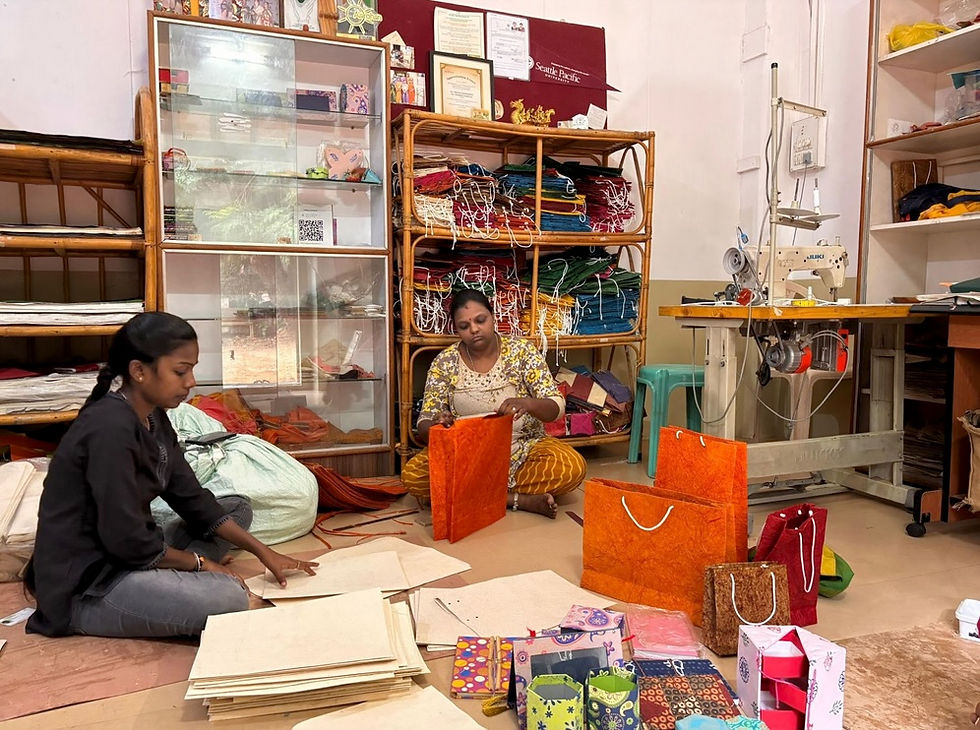
Janaki: We make everything at this one place, here in Canara Union—recycled, handmade, and eco-friendly products. We source our papers from Jaipur and make products such as bags, pen stands, jewelry boxes, photo frames, and others using them. We have also started stitching bags using clothes brought in through public donations.
Ramadevi: Before Covid, we were on 10th Main, but the rent increased after the pandemic, which is why we came here to Canara Union, where the rent was more affordable.
This business is a learning lesson for us. At home, I have to look after my family, but that is only one part of my life; to work here gives me purpose and makes another part of my life. Before we joined, neither of us knew how to work a sewing machine or make any handmade products, but we learned these skills here through training. Even just six months back, we were unfamiliar with certain skills, but we are constantly learning and growing.
Crafting Lives: The URVEE Story
