


Ancient Origins, Royal Consecration
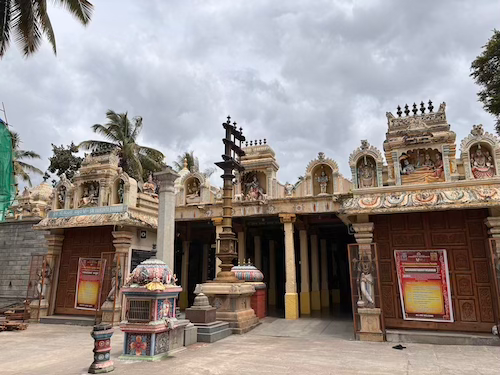
Sri Venugopalaswamy Temple stands as one of Malleswaram's oldest and most historically significant religious monuments, with roots extending over a thousand years. Though the current temple structure was consecrated in 1902 to commemorate Nalvadi Krishnaraja Wodeyar's assumption of administrative duties in Mysore, the temple's sacred elements carry far more ancient lineage. The temple's main deity possesses remarkable antiquity, dating back to 977 AD, making it over a millennium old.
This sacred idol was brought from Tirukkonlur by S. Venkatranga Iyengar, who rescued it from a dilapidated temple after obtaining proper authorization from local authorities. The temple was subsequently constructed by the Vaishnava community under Iyengar's supervision and patronage, who served as diwan to King Krishnaraja Wodeyar.
Transforming Wilderness into Community
The area originally known as Kadu Malleswara was characterized by dense forest surrounding an ancient Shiva temple. Through S. Venkatranga Iyengar's vision and efforts, this wilderness was transformed into a thriving neighborhood, eventually renamed Malleswaram. The temple became the focal point of this development, with its four gopuras (entrance towers) providing welcoming access for devotees from all directions.
Architectural Layers of History
The temple's construction demonstrates fascinating historical layering through the reuse of materials from older structures. Visitors can observe sculptures and stonework in the superstructure that predate the rest of the building, as these elements were incorporated from two Anjaneya temples, one Basavanna temple, and even a sluice gate from Basavangudi's Karaji Kere. This architectural recycling reflects both practical considerations and reverence for sacred materials.
Royal Connections and Divine Lineage
The temple's royal connections are particularly noteworthy. Both the utsava idol and the Lakshmi idol originated from the Krishna temple within Mysore Palace, establishing direct links to the royal household. This connection deepened through the shared Yadu vamsha lineage of both the Wodeyar dynasty and Lord Krishna, creating a symbolic unity between temporal and divine authority.
Dedicated to Lord Krishna, the temple houses three avatars of Vishnu—Krishna, Narasimha, and Rama—representing divine interventions sent to restore cosmic balance. The temple's consecration was deliberately synchronized with Nalvadi Krishnaraja Wodeyar's coronation, symbolically establishing that the king serves as part of the divine order.
Religious Traditions and Cultural Life
Operating within Vaishnava traditions, the temple conducts all rituals according to Agama Shastra principles. Its stone-pillared courtyard and auditorium serve as venues for continuous religious and cultural programming throughout the year, including classical music and dance performances that enrich the community's spiritual life.
A Calendar of Celebrations
The temple maintains an extraordinarily active festival calendar, hosting approximately 200 celebrations annually. The most spectacular is the annual Rathotsava (chariot festival), featuring a chariot crafted from silver and gold, reportedly the largest in Bangalore. Krishna Jayanti receives special emphasis, with celebrations extending over 15 days, reflecting the deity's central importance.
Enduring Royal Patronage
The temple's centenary celebration witnessed the presence of Srikantadatta Wodeyar, demonstrating the enduring royal patronage that has sustained this ancient institution through more than a century of social and political change. This continuity of support has ensured the temple's preservation and continued relevance in modern Bangalore.
A Living Heritage
The Sri Venugopalaswamy Temple represents more than religious architecture; it embodies the transformation of Bangalore from princely state to modern metropolis while maintaining sacred traditions. Its millennium-old deity, royal connections, and community-centered approach have made it not merely a place of worship but a living heritage that continues to shape the cultural identity of Malleswaram and beyond.
Sri Venugopalakrishna Swamy Temple
