


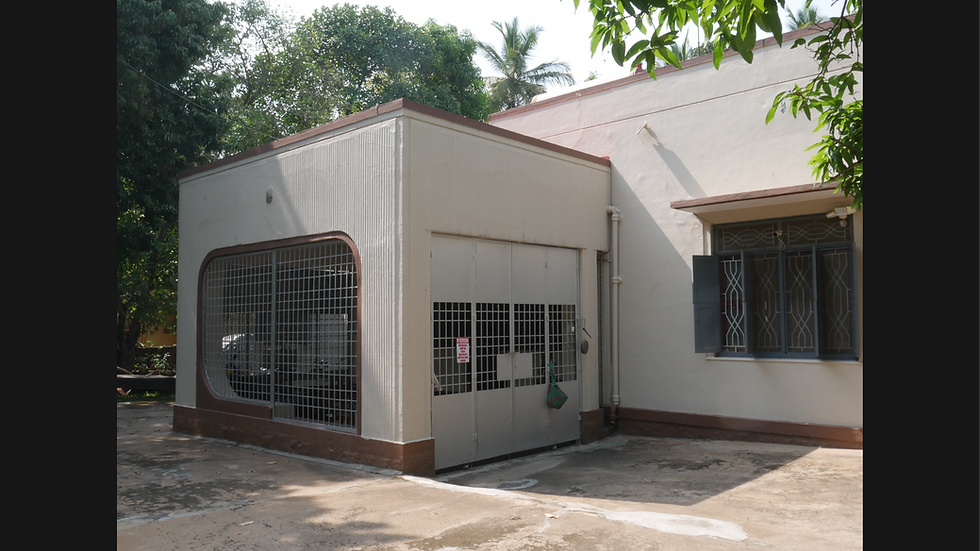
The Builder and Designer
This house was built from 1946 to 1948 by Seshu Iyer, father of the present owner Mr. Subrahmanyam. But here's the remarkable part: while Seshu Iyer provided the funds, it was his wife who designed the house, right down to the smallest detail. She had only studied until age 11 or 12, and despite caring for a large brood of children and an extended family, she managed this difficult task.
The Neighborhood Then and Now
When the house was built, there were no other houses on 17th cross. It was considered a modern house at the time. Much of the area around their home was actually agricultural land. The road outside was made of mud, as all the paved roads stopped at 15th cross. Their road didn't get tarred until the 1950s, and rain water drains weren't installed until the 1960s. Mr. Subrahmanyam remembers playing cricket in the compound of famous painter Venkatappa, cutting across neighbors' compounds. No high walls separated homes as they do now!
Building During Rationing
This was the time around Indian independence, and rationing was in effect. Construction materials like steel and cement were in short supply. Petrol was difficult to get, with government quotas and lots of paperwork needed to source anything required for the work. Cement and steel had to be picked up from Bhadravathi, about an 8-hour ride from Bangalore. Teakwood and rosewood was bought at auctions in Shimoga and Hunsur.
Manual Construction Methods
A large pit measuring 15'x15'x12' was dug for cutting the wood. Two people manually cut the logs—one standing inside the pit and one outside—and 30-40 logs were cut this way. Lime was prepared inside their own compound while bricks were made across the road. The mud for the walls came from the foundation excavation. Internal walls were 18" thick and external walls were 21" thick. The foundations went down 12'-15' at one end and 7'-8' at the other end, made of stone that was plentiful at that time.
Innovative Building Techniques
The columns and roof slab were made of RCC, a new material at that time, but columns were used only in the verandah. The rest of the house had load-bearing walls. Lintels were made of stone. The steel window grills were put together by riveting, not welding. This meant the laps had to be planned in advance and very exact so the patterns could be created accurately. The flooring was a mix of red oxide and terrazzo. The terrazzo tiles came already polished from a factory in Coimbatore.
A Different Ethos
Today, the house still stands with very few modifications, in a beautiful garden and set back from the road. When you step in, you also step into a different world - a world that was slower, gentler; where people had time for each other and doors were always kept open for visitors. The house is a testament to a different ethos - one that has left us forever.
Sheshu Iyer House


