


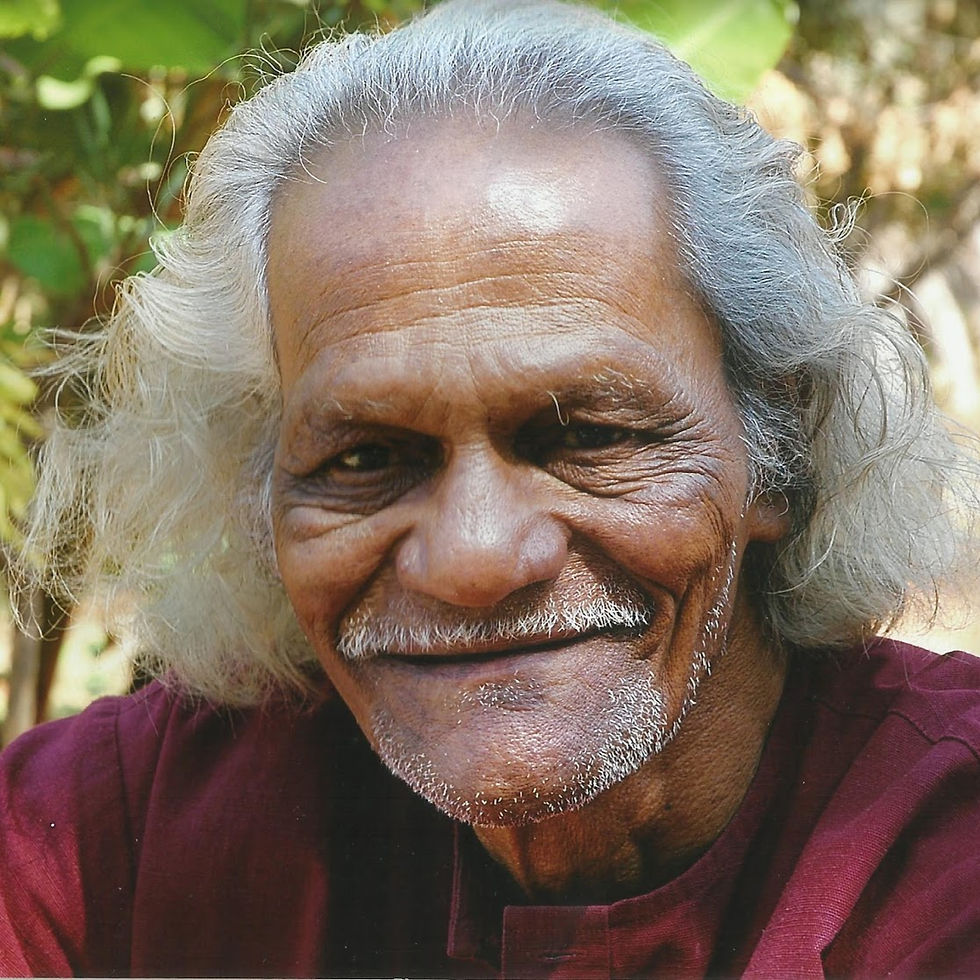
M. B. Patil (1939–2017) was one of Karnataka's most respected modern artists, remembered as much for his extraordinary portrait demonstrations as for his paintings. Regarded by many contemporaries as a master of portraiture, he could complete a lifelike portrait in just ten to fifteen minutes before audiences of students and fellow artists. His demonstrations emphasised careful observation, proportion, the play of light and shadow, skin tones and the disciplined practice of drawing. Having conducted more than sixty portrait demonstrations at art schools across Karnataka, he inspired generations of young artists while advocating rigorous training from live models. Over a career spanning more than five decades, Patil worked across portraiture, figurative painting, murals, abstraction and exhibition design, while remaining a generous mentor to the state's artistic community.
Growing Up in Tikota
Mallikarjuna Bheemanagowda Patil was born in 1939 in Tikota, a small town in present-day Vijayapura (Bijapur) district, then part of a princely state. His childhood was marked by financial hardship. While his father, Bheemangouda, viewed his son's interest in art with scepticism, his elder brother Shivanagouda recognised his talent and encouraged him to pursue it.
Patil often recalled that his fascination with art began almost as soon as he could remember.
"From the age of two I was interested in art... I was always attracted to decorative pots, vessels, walls and floor designs. If I saw someone making a Ganesha idol, I would even skip lunch just to watch."
In school, drawing was taught only once a week, but it was enough to deepen his interest. After matriculation, encouraged by a family friend, he was allowed to leave for Bombay to study art.
Learning to Become an Artist
Patil had hoped to join the prestigious Sir J. J. School of Art, but by the time he reached Bombay admissions had closed. On the advice of the Drawing Inspector, he instead enrolled at Nootan Kala Mandir, where he studied under the renowned teacher G. S. Dandavatimath alongside artists such as A. A. Almelkar.
Those years shaped his remarkable discipline.
Paper was scarce, and friends often lent him drawing materials. Patil later remembered completing nearly a hundred drawings a day, sometimes finishing three portrait sittings in a single day, simply because he wanted to practise as much as possible.
A Working Artist
After graduation, Patil took up a series of odd jobs, including colouring old photographs and working briefly in film studios. He later moved to Hubballi, where he worked at the Medical College before joining the Karnataka Department of Information and Publicity as an artist.
The government job provided stability for his growing family and gave him opportunities to work on large public projects. Rising steadily through the department, he eventually retired as Assistant Director in 1998.
Among his most significant contributions were the elaborate government exhibition displays and Republic Day tableaux representing Karnataka in New Delhi. Patil's tableaux won national recognition on five occasions, though colleagues often remarked that his own artistic contribution was never fully acknowledged.
An Artist Rooted in North Karnataka
Although he spent most of his career living in Malleswaram, Patil never lost his connection to his native North Karnataka. The people, landscapes and visual culture of Tikota and the wider Hyderabad–Karnataka region remained central to his work. Village women in Ilkal saris, farmers, market scenes and everyday rural life appeared repeatedly in his paintings, reflecting the region that had shaped him.
His work can broadly be understood in three strands: figurative folk-inspired paintings, collages, and portraiture. He was particularly known for his folk-inspired compositions, including his distinctive burnt-wood style, as well as paintings featuring elongated figures, flat planes of colour and bold silhouettes. Working primarily in acrylic, he developed compositions that drew from the visual traditions of North Karnataka while remaining firmly within the language of modern Indian art.
Alongside these works, Patil explored nature-based abstraction, using abstract compositions to study colour, space, depth and balance. He also worked in murals, landscapes and exhibition design, and contributed art direction to several documentary-drama films.
Drawing lay at the heart of his practice. As a student in Bombay, he is said to have completed nearly a hundred sketches a day whenever paper was available. Later, while travelling across Karnataka for his work in the Information and Publicity Department, he spent evenings sketching people in markets and public spaces. These observations became the foundation of many of his figurative compositions.
Mentor, Friend and Teacher
Patil's home studio on 17th Cross, Malleswaram became an open house for young artists.
Students, friends and fellow painters regularly dropped in, often staying for hours discussing art, literature and life. Those who knew him remembered that conversations frequently became so engaging that he would postpone his own painting altogether.
Artist Manjunath Kalledevar, one of his closest students, recalled visiting him to document his working process before a scheduled exhibition, only to discover that Patil had not yet begun painting. It was only after being persuaded that he finally started work, later thanking Kalledevar for pushing him to paint.
Recognition and Legacy
Over a career spanning more than five decades, M. B. Patil held eight solo exhibitions between 1969 and 1998 across Hubballi, Dharwad, Kalaburagi, Kittur, Hyderabad and Bengaluru. From 1975 onwards, he participated in more than twenty-five group exhibitions organised by leading institutions including Max Mueller Bhavan, Alliance Française, Venkatappa Art Gallery, and the Karnataka Chitrakala Parishath. He was also an invited participant at around thirty national and state-level art camps, later directing Karnataka Lalit Kala Akademi camps in Hampi and Bengaluru.
His works are held in the collections of the Karnataka Lalit Kala Akademi, Andhra Lalit Kala Akademi, the Lalit Kala Akademi, New Delhi, and several private collections in India and abroad.
His contributions to Indian art were recognised with numerous honours, including the Karnataka Lalit Kala Akademi Honour Award (1986–87), Karnataka Lalit Kala Akademi Competition Award (1993), Sahitya Sammelana Award, Bagalkot Achar Award (2002), Sir M. Visvesvaraya Foundation Award (2002), the Karnataka Rajyotsava Award (2003), and the Varnashilpi K. Venkatappa Award (2008).
Sources and References
Article by Suresh Jayaram on Bangaloremirror
https://www.artsceneindia.com/2017/09/a-tribute-to-artist-mb-patil.html
Article by H.A. Anil Kumar on ArtScene India
https://pramilalochan.blogspot.com/2015/12/mbpatil.html
Art and Artist by Pramila Lochan published in Ananya Kalasinchana
Article by Jayanthi Madhukar on Bangaloremirror
‘Malleswarada Rashtra Shilpigalu - Brief life sketches in Kannada of eminent citizens and organisations of Malleswaram Locality ‘
Published by: Malleswaram Residents Welfare Association
M. B. Patil
